The Enigma Unveiled at Ravenwood Manor


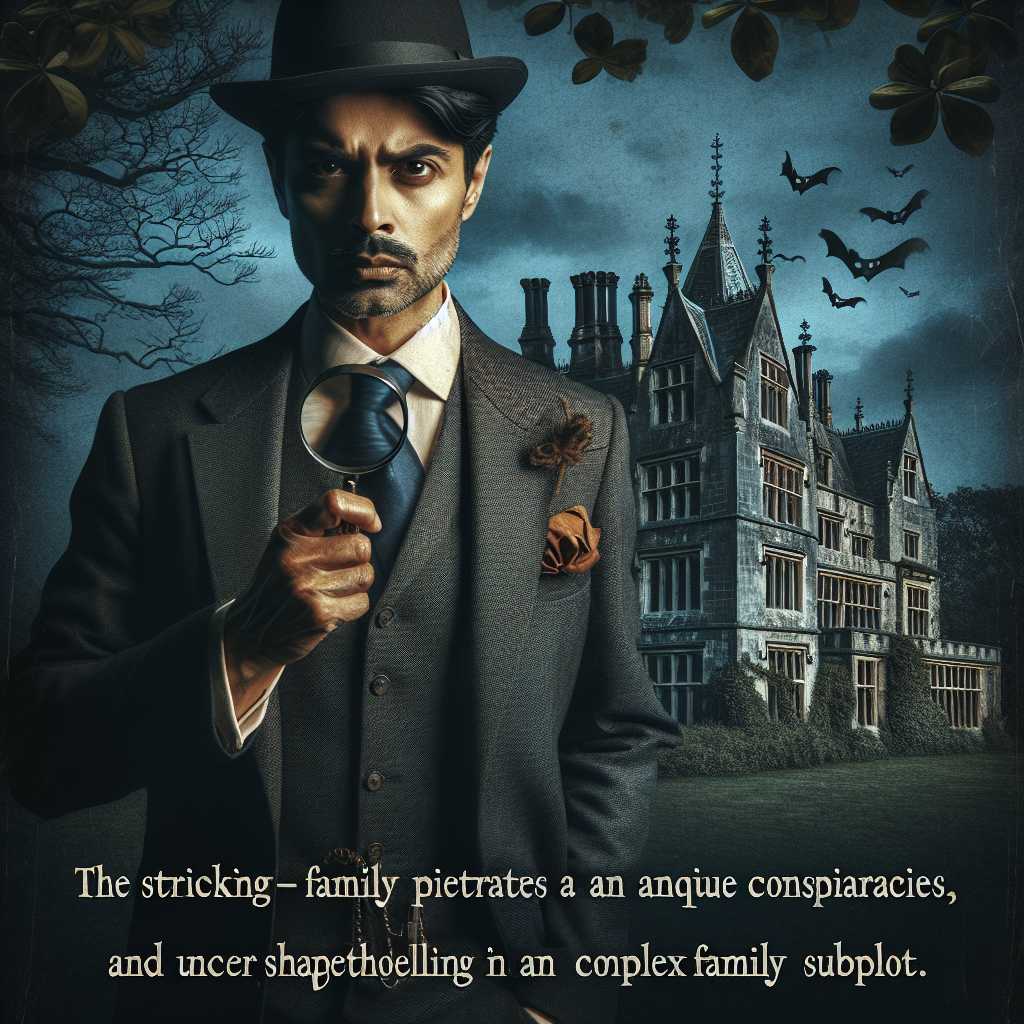
It was a dreary autumn evening when Detective Samuel Hawthorne arrived at the gates of Ravenwood Manor. The manor loomed ominously against the backdrop of the fading daylight, its towering spires clawing at the darkening sky. As the wind howled through the ancient trees that surrounded the estate, the detective pulled his trench coat tightly around himself, steeling his resolve for the enigma that awaited him within.
Hawthorne had been summoned by Lady Agatha Cranfield, the widow who resided in the manor. Her voice, tremulous with urgency, had beckoned him to solve a mystery that threatened to tear apart her already fragile world. The butler, an austere man named Benson, greeted Hawthorne at the door with a curt nod.
“Lady Agatha is expecting you in the drawing room, Detective,” Benson intoned, his voice as clipped as his appearance.
As Hawthorne stepped inside, the manor exuded an atmosphere both grand and oppressive, its marble floors and ornate woodwork bearing testimony to a bygone era of aristocracy. He found Lady Agatha seated in a high-backed chair by the fireplace, her frail frame wrapped in a shawl, her eyes shadowed with worry.
“Detective Hawthorne,” she began, her voice barely above a whisper, “thank you for coming on such short notice.”
“My pleasure, Lady Agatha. How may I be of service?” Hawthorne replied, taking a seat opposite her.
“It’s about my late husband, Lord Cranfield,” she confessed, her gaze fixed on the crackling flames. “There have been... incidents. Strange happenings that defy explanation.”
Hawthorne listened intently as Lady Agatha recounted the events that had unfolded since her husband’s untimely death six months prior. Items had gone missing, footsteps echoed through empty corridors, and the chilling sound of piano keys struck themselves in the dead of night. The manor's inhabitants were restless, on edge.
“The locals whisper of a curse, Detective,” she confided. “They say that Ravenwood Manor is haunted.”
Hawthorne leaned back, his mind racing through possibilities. He had little patience for superstitions, preferring concrete evidence over folklore. His instincts told him there was more to this tale than ethereal apparitions.
“Fear not, Lady Agatha. I am not one to be deterred by ghost stories. Allow me to investigate and uncover the truth,” he assured her, rising to his feet.
His first order of business was to inspect Lord Cranfield’s study, believed by the household to be the epicenter of the disturbances. As he crossed the threshold, Hawthorne noted the room’s disarray—a stark contrast to the rest of the meticulously maintained manor. Papers littered the desk, and an array of books lay haphazardly on the shelves.
It was there that Hawthorne found his first clue: a slip of paper containing a string of numbers. They seemed random, yet his experienced eye caught the faintest hint of a pattern. Tucking the paper into his pocket, he continued his search, examining the room for further evidence.
As he paced the floor, a peculiar thought struck Hawthorne. Could these numbers be a code, perhaps a combination or cipher?
The following day, rather than confronting Lady Agatha with premature theories, Hawthorne decided to question the staff. Each member of the household was respectful, yet evasive, offering little beyond whispered rumors of eerie occurrences. However, when he spoke to the young maid, Eliza, he caught a twinkle of something different in her eye—fear, yes, but also recognition.
“Miss Eliza,” Hawthorne began, his tone gentle but firm, “what do you know of these disturbances?”
Eliza hesitated, her gaze darting about as if she feared being overheard. “I... I’ve seen a figure, sir. Late at night, in the gardens. It moves silently, like a shadow.”
“Have you recognized this figure?”
She shook her head, biting her lip. “Only once, sir. I thought I saw them near the old gardener’s shed. But when I followed, they vanished.”
Intrigued, Hawthorne thanked Eliza for her courage and ventured to the gardens that evening, shrouded in darkness except for the glow of his lantern. The shed, a dilapidated structure, was indeed suspect—its door creaked open with an eerie wail as he approached.
Inside, Hawthorne discovered a trove of curiosities: tools that were not for gardening but rather for crafting, stacks of old newspaper clippings, and a ledger half-buried beneath piles of soil-stained rags. The ledger’s pages were filled with meticulous records of financial transactions, indicating substantial sums of money being moved in and out of accounts he did not recognize.
Understanding dawned upon the detective; Lord Cranfield, before his death, was likely entangled in some clandestine affair of significant magnitude. Could it be that someone in the household coveted or attempted to conceal his secret dealings?
The manor bore an oppressive silence when he returned, yet in the shadows, Hawthorne felt eyes upon him. He knew he was close, the pieces of the puzzle aligning within his mind.
In the days that followed, Hawthorne pieced together the rest of the mystery, pulling at threads until they unraveled into a network of deceit. A disgruntled family member, spurned by old grievances and avarice, had orchestrated a scheme to benefit from the late lord’s holdings post mortem.
When faced with the evidence, Lady Agatha, though heartbroken, was relieved to have an explanation, and the manor's oppressive atmosphere dissipated as she took solace in knowing the truth.
As Detective Samuel Hawthorne departed Ravenwood Manor beneath a crisp, clear sky, he felt a familiar satisfaction, the kind that followed a case well solved. The ghosts of Ravenwood had been laid to rest, their secrets revealed under the unyielding light of justice.