Yuna’s Strawberry Jam in the Nurse’s Office

The Jar in the Nurse’s Office
The first time I saw Dr. Han steal medicine, he was wearing a reindeer headband that blinked red over his left ear.
I was seventeen, a second-year student at Daejin High School in Seoul, and I had been sent to the nurse’s office with a nosebleed caused by an elbow during lunch soccer. Outside, the courtyard was powdered with old snow, gray at the edges from shoe soles. Inside, the radiator clanked like someone knocking from inside the wall.
Dr. Han stood with his back to me, sliding a box of fever patches into the deep pocket of his white coat.
“I saw that,” I said, pinching tissue under my nostrils.
He froze. The reindeer antlers flashed twice.
Then he turned, and I saw how tired he was. His cheeks were hollow, his jaw rough with two days of beard. He had the kind of hands adults called beautiful—long fingers, clean nails—but they shook as he lifted them.
“You are bleeding on your uniform,” he said.
“You are stealing from school.”
He looked at the pocket, then at the door. “Sit down, Miss…?”
“Seo Minji.”
“Sit down, Seo Minji. Tilt forward, not back.”
I didn’t move. At Daejin, rumors moved faster than cafeteria tteokbokki disappeared. We all knew about him. Han Jun-seo, once a surgeon at a famous hospital in Gangnam. A patient had died. News vans had camped outside. He had left medicine, or medicine had thrown him out. Nobody knew why a disgraced doctor had accepted a temporary job as our school health teacher for December.
“If I report you,” I said, “they’ll fire you.”
His mouth twitched, not quite a smile. “Very likely.”
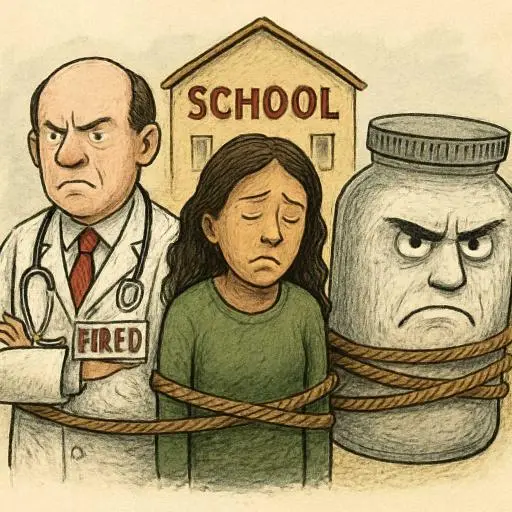
On his desk sat a jar of homemade strawberry jam, tied with a red ribbon. The fruit inside glowed thick and dark, like rubies crushed with sugar. A paper tag hung from the lid.
For Dr. Han. Please come to the concert. I kept my promise. — Yuna
I read it before he snatched the jar and put it in a drawer.
“Who’s Yuna?” I asked.
For the first time, his hands stopped shaking.
“Someone,” he said, “I promised not to fail.”
Years later, when people ask why I became a journalist instead of a lawyer like my mother wanted, I think of that jar of jam and the man who looked more afraid of breaking a promise than losing his job.
What Everyone Knew
In December, Seoul smells of roasted chestnuts, exhaust, wet wool, and the sweet fish-shaped bread sold outside subway exits. That winter, our school smelled mostly of disinfectant and panic. Final exams were near, university results were beginning, and the choir director had decided our Christmas concert would “heal the community.”
“Heal us from what?” my friend Park Doyeon whispered during rehearsal. “Bad harmonies?”
From the back row, Yuna coughed.
Her full name was Kang Yuna. She was in my class, small enough that teachers always asked boys to carry her textbooks, which made her bare her teeth like an alley cat. She wore yellow mittens even indoors because her fingers went pale in the cold. She sang alto, low and steady, as if the notes were stones she could step on across water.
She had brought the jam.
I found that out the next day when I followed Dr. Han after school. I told myself I was doing civic duty. Really, I was curious and angry in the way seventeen-year-olds are when adults prove rotten.
He left through the side gate, carrying a paper bag. I followed him past stationery shops glowing with Christmas stickers, past a church where children practiced bells, to a basement room behind a pharmacy. A blue sign read: Jungnim Free Clinic, Tuesdays and Thursdays.
Inside, elderly men sat with swollen ankles. A migrant worker held a child wrapped in a padded jacket. Dr. Han took off the reindeer headband, put on a stethoscope, and became someone else.
“You’re late,” said a woman in a purple fleece vest.
“School meeting,” he said. “Sorry, Nurse Oh.”
He opened his bag. Fever patches. Bandages. Cough syrup samples. Nothing dramatic. Nothing worth prison. But stolen was stolen.
Then Yuna appeared from behind a curtain, dragging an IV pole.
“Minji?” she said.
I knocked my shin into a chair.
Dr. Han looked at me once, then closed his eyes as if counting to ten.
“You followed me.”
“You lied to school.”
“Yes.”
Yuna’s lips were dry, cracked at one corner. “Don’t report him.”
“Why are you here?” I asked.
She lifted her chin. “Because I’m selfish. I got sick at a very inconvenient time.”
Nurse Oh clicked her tongue. “Leukemia is not selfish.”
The word landed between us and stayed there, heavy as a dropped bag of rice.
Dr. Han rubbed his forehead. “Minji, go home.”
“What promise?” I asked. “The one on the jam.”
Yuna looked at him. He looked away.
She answered for him. “He promised I’d sing at the Christmas concert.”
“Can you?”
Her fingers tightened around the IV pole until the knuckles shone. “I made jam in summer when I still had eyebrows. I told him if I lived until Christmas, he had to eat it after hearing me sing.”
Dr. Han picked up a chart. His voice was flat. “Her counts are low. A fever could kill her.”
Yuna snapped, “Then don’t let me get a fever.”
He flinched.
That was when I understood. The hard promise was not to bring her to the concert. It was to keep her alive long enough to break her heart.
The Promise Tightens
For three days, I kept Dr. Han’s secret in my mouth like a fishbone.
At home, my mother cut apples with sharp, clean movements. “Why are you quiet?”
“Exam stress.”
She gave me a slice. “Report any teacher who behaves strangely. Schools hide too much.”
I nearly choked.
At school, Dr. Han treated headaches, cramps, paper cuts, and one first-year boy who glued his hand to a desk during art club. He never mentioned the clinic. He never mentioned Yuna.
But Yuna got paler.
During choir, she pressed a mittened hand to her ribs after every song. Our director, Ms. Baek, frowned over her glasses.
“Kang Yuna, if you are unwell, sit out.”
“If I sit out, the altos sound like dying ducks,” Yuna said.
Doyeon whispered, “True.”
Ms. Baek hid a smile behind her sheet music.
On Friday morning, the vice principal marched into our classroom with two police officers and the smell of expensive cologne.
“Students,” he said, “remain seated.”
Dr. Han stood beside him, face colorless.
My stomach dropped. Someone had reported the missing supplies.
The vice principal held up a printed inventory. “We are investigating theft from the nurse’s office. Dr. Han has admitted to removing school property.”
A ripple went through the room.
Yuna stood so fast her chair screamed against the floor. “It was for patients.”
Dr. Han said, “Sit down.”
“No.” Her voice cracked, but she kept going. “He treats people for free. Old people. Kids. Me.”
The vice principal’s eyes sharpened. “Kang Yuna, this is not your concern.”
“It is exactly my concern!”
She coughed into her mitten. When she lowered it, there was a bright red spot on the yellow wool.
Everything stopped.
Dr. Han crossed the room in three strides. “Yuna.”
She tried to wave him away. “Don’t look at me like that.”
He touched her forehead, then her wrist. His face changed—not fear, not surprise, something faster and colder.
“She needs a hospital.”
“Dr. Han,” the vice principal said, “you are not authorized—”
“Call an ambulance.”
“You no longer have—”
Dr. Han turned on him, and for one second the disgraced doctor vanished. In his place stood the surgeon from the news, the man who had once cut people open and dared death to argue.
“Call the ambulance,” he said, “or move.”
I moved first. I grabbed the classroom phone.
As I dialed, Yuna caught my sleeve.
“Minji,” she whispered, teeth chattering. “The jam.”
“What?”
“Don’t let them throw it away.”
Only Yuna would be bleeding into a mitten and worrying about jam.
Christmas Eve Rehearsal
The school fired Dr. Han before sunset.
They did it by phone while he sat in the hospital corridor, his coat folded over his knees, the reindeer headband sticking from one pocket like a dead insect. I know because I was there. Yuna’s parents were in Busan, trapped by a delayed train, and Nurse Oh had sent me to bring documents from school.
“Yes,” he said into the phone. “I understand.”
He listened.
His thumb rubbed a brown stain on his cuff. Strawberry jam, I realized. The jar had leaked in my backpack because I had rescued it from the nurse’s office drawer and carried it like evidence.
When he hung up, I put the jar on the chair beside him.
“She told me not to let them throw it away.”
He looked at it for a long time.
“I killed a boy,” he said.
I stopped breathing.
“That’s what the news said.” His voice scraped. “During surgery, there was a delay. Equipment failure. I made the wrong call after that. His family wanted someone to blame. I wanted someone to blame too, so I chose myself.”
Down the hall, a monitor beeped steadily.
“Yuna was in the ward then,” he said. “Different illness, earlier round. She saw reporters shouting at me. The next week she brought jam. Awful jam. Too much sugar. Seeds everywhere.”
“That sounds like Yuna.”
His mouth bent.
“She said, ‘Doctors who quit still have hands.’ I told her I wasn’t her doctor anymore. She said, ‘Then be my audience.’”
I leaned against the wall. My legs felt loose.
“Why promise the concert?”
He unscrewed the lid. Sweet strawberry filled the corridor, bright and summery, absurd among bleach and plastic tubing.
“Because she asked me on a day when everyone else was asking me to disappear.”
Yuna woke near midnight.
Her fever had dropped, but the doctors had forbidden visitors beyond family. Dr. Han stood outside the glass, not allowed in. Fired teachers, disgraced doctors, and thieves of fever patches were not welcome in pediatric hematology.
Yuna saw him anyway.
She lifted one weak hand and pointed at her throat.
He shook his head.
She pointed again, harder.
I was close enough to hear him whisper, “No.”
Yuna mouthed something.
“What did she say?” I asked.
He closed his eyes.
“She said, ‘Promise.’”
Christmas Eve arrived with hard blue sky and air so cold it made the inside of your nose sting. At school, the concert went on because institutions are machines; they grind forward unless someone jams a spoon into the gears.
I stole the spoon.
Doyeon stole the auditorium key. Ms. Baek pretended not to see us run extension cords through the hallway. Nurse Oh borrowed a hospital tablet. Dr. Han, who was banned from campus, stood outside the rear auditorium door wearing a black coat and no headband.
“This is a bad idea,” he said.
“Yes,” I said. “Come in.”
“I am not allowed.”
“Neither was stealing cough syrup.”
He gave me a tired look. “You have become troublesome.”
“I learned from adults.”
The Song With No Solo
The auditorium was packed with parents holding phones, younger siblings kicking chair backs, and teachers pretending not to cry during “Silent Night.” Paper snowflakes hung from the ceiling. Someone had taped cotton to the piano, where it sagged like old rice cake.
When our choir lined up, Yuna’s space in the alto row was empty.
Ms. Baek raised her hands.
Then the projector screen lowered behind us.
A murmur rolled through the room.
Yuna appeared on the screen from her hospital bed, cheeks pale, yellow mittens on both hands. Tubes ran from her arm. Her mother sat beside her, wiping her nose with a tissue and trying not to appear on camera. Nurse Oh adjusted the tablet.
Dr. Han stood in the shadow near the side door, hidden from most of the room. But Yuna saw him. Her eyes narrowed.
“Closer,” she rasped through the speakers.
The audience laughed softly.
Dr. Han stepped into the aisle.
The vice principal rose halfway from his seat. Ms. Baek lowered one hand just enough to point at him like a blade.
He sat down.
Yuna smiled.
We began.
Not “Silent Night.” Yuna hated that one. Ms. Baek had changed the program at the last minute to a Korean carol about a child carrying a candle through winter streets. Yuna’s voice came through thin at first, nearly lost under our altos. Then we softened. Sopranos, tenors, all of us leaned back and made room.
Her note steadied.
It was not beautiful in the polished way judges liked. It wavered. It caught. It carried the dry hospital air, the beep of machines, the stubbornness of a girl who had made jam in summer because she intended to reach winter.
In the second verse, she stopped.
Dr. Han gripped the seat in front of him.
Yuna swallowed, then spoke into the tablet.
“Doctor.”
No one breathed.
“Eat it.”
Doyeon shoved the jar into my hands. I ran down the aisle and gave it to him.
His fingers fumbled with the ribbon. The lid stuck. A father in the front row offered his handkerchief. Dr. Han wrapped it around the lid and twisted. Pop.
The strawberry smell bloomed through the auditorium.
He had no spoon.
For one awful, perfect second, everyone watched this ruined surgeon, this fired school doctor, this thief of bandages, stare helplessly into a jar of jam.
Then the vice principal, red-faced, reached into his suit pocket and produced a plastic coffee stirrer.
“Use this,” he muttered.
The auditorium burst into laughter.
Dr. Han dipped the stirrer, tasted the jam, and winced.
Yuna’s grin filled the screen. “Too sweet?”
He swallowed. His eyes shone, but his voice held.
“Terrible.”
She laughed so hard Nurse Oh told her to stop wasting oxygen.
We finished the song without a solo because, by then, the whole room was singing.
Looking back, I wish I could say Yuna recovered fully, that Christmas repaired blood and bone. It did not. She died the following autumn, after one more summer and one more batch of jam, this time apricot and somehow worse.
But Dr. Han kept his promise.
And another one, though he never said it aloud.
The video of that concert spread across Seoul. Not because of perfect music, but because people like seeing a disgraced man eat awful jam for a girl who refused to vanish quietly. Donations filled the free clinic’s account. A hospital review board reopened his case. The truth, messier and less satisfying than gossip, came out.
Years later, when I interviewed Dr. Han at the Jungnim Children’s Clinic, he had gray at his temples and a shelf full of jam jars from patients. Strawberry, plum, citron, fig.
“Do you eat them?” I asked.
He looked offended. “Every one.”
On his desk sat an old jar, empty now, with a faded red ribbon and a tag in Yuna’s crooked handwriting.
I asked if I could photograph it.
He shook his head.
“Some things,” he said, resting one hand over the lid, “are not evidence.”
Outside, students from the high school were singing carols badly near the clinic entrance, collecting money in a cardboard box. Dr. Han opened the window and shouted, “Altos, you are flat!”
A girl shouted back, “Then come teach us, Doctor!”
He glanced at the empty jar, then at me.
“You heard her,” he said, reaching for his coat.
And for the first time in all the years I had known him, he left the room as if someone were waiting, and he was not too late.
This story was created with the help of AI writing tools and published by Storyleo Editorial.